Updated on Dec, 22 2025 03:14 IST
Study Nuclear Engineering in France





Study Masters
Test Preparations
About Us
Knowledge Hub

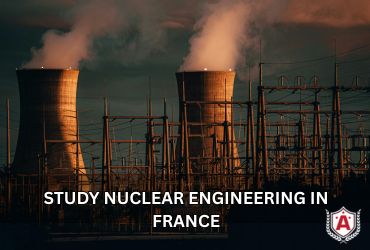 Do you ever think about how electricity is created and managed carefully to power our homes and cities every day? This idea is connected to nuclear engineering. Studying nuclear engineering in France helps students understand how nuclear energy is produced and used in a careful and responsible way. France is one of the top countries in the world that depends on nuclear power for electricity. This makes it a strong place to study this field. Universities in France focus on simple concepts, practical learning and real life training. During this course, students can explore key areas such as energy systems, safety methods and modern tools used in nuclear plants. The teaching style helps them understand the subject in a practical way. France also offers a safe and welcoming study environment for international students. Many programs are available in English, which makes learning easier for students from different countries. After graduation, students can explore career options in energy, research and technology sectors. If you are interested in studying this field, Anigdha will be here to help you.
Students must meet a few basic requirements before applying. These conditions are explained separately for bachelor’s and master’s programs.
Bachelor’s Eligibility Criteria
Academic qualification: Students must complete Class 12 or an equivalent school education from a recognized board before applying to nuclear engineering programs.
Relevant subjects: Physics and Mathematics are very important subjects for nuclear engineering. Chemistry is also useful for understanding energy and material concepts.
Minimum score: Most universities expect students to score around 60 percent or more in core science subjects during school education.
Application submission: Students must fill out the online application form correctly and submit it before the university deadline.
Academic records: School mark sheets, certificates, passport copy and identity proof must be submitted during the application process.
Selection process: Many universities select students based on academic performance and document review without any written entrance test.
Language waiver: Some universities may allow a language test waiver if previous studies were fully completed in English.
Health coverage: All international students must have valid health insurance before beginning their studies in France.
Language requirement: Students must show proof of English or French language ability depending on the course teaching language.
IELTS score: Between 6.0 and 6.5
TOEFL score: Around 80 or higher.
Master’s Eligibility Criteria
Educational background: Students must complete a bachelor’s degree in nuclear, mechanical, electrical, physics, chemical engineering or a related technical field.
Academic performance: Universities expect consistent academic results and good understanding of science and engineering subjects.
Application form: Applicants must complete the online application form through the university website before the deadline.
Supporting documents: Degree certificate, academic transcripts, passport copy, CV and recommendation letters must be submitted.
Entrance assessment: Most universities do not require GRE or GMAT. Some programs may conduct an interview to assess subject knowledge.
Work experience: Previous technical training or internships can be helpful but are not compulsory for admission.
Exemption option: Language test scores may not be required if earlier education was taught entirely in English.
Medical insurance: Health insurance is mandatory for the complete study period in France.
Language proficiency: English language test scores must be submitted for programs taught in English.
IELTS score: 6.5 and above
TOEFL score: 85 or above is generally accepted.
Students planning to study Nuclear Engineering in France should understand the intake periods early. Most universities in France offer two main intakes each year. The main intake begins in September and includes most nuclear engineering programs. Applications usually open from December and remain available until March or April. Some universities may accept applications until May, depending on seat availability. A January intake is also offered by a few universities but course choices are limited. However, planning early helps students collect documents on time and complete each step smoothly. This increases admission chances and reduces last minute stress.
Here is the list of documents generally required while applying for a Bachelor’s degree in Nuclear Engineering in France:
A valid passport copy with clear personal details page.
The government issued identity proof.
Completed university application form.
Senior secondary school academic transcripts.
Higher secondary school completion certificate.
Recent passport-size photographs.
Proof of English language proficiency.
Statement of motivation explaining academic interest.
Academic reference letters from school authorities.
Updated academic profile or resume.
Offer or admission letter issued by the university.
Proof of financial resources for study and living expenses.
Health insurance coverage valid in France.
Student visa application form.
Proof of accommodation arrangement in France.
Here is the list of documents commonly required for a Master’s degree in Nuclear Engineering in France:
A valid passport copy
National identity document.
Completed application form of the chosen university.
Academic transcripts from secondary education and bachelor’s degree.
Bachelor’s degree completion certificate.
Recent passport-size photographs.
Proof of English language proficiency.
Statement of purpose describing academic goals.
Letters of recommendation from university faculty.
Updated CV with academic details.
Provisional certificate or final degree certificates.
Official admission or acceptance letter from the university
Proof of sufficient financial funds or scholarship confirmation.
Health insurance valid for the duration of study.
Student visa application form.
Study plan outlining academic focus and future goals.
Many students worry that language may become a problem while studying abroad. However French universities offer flexibility in teaching languages, which makes learning easier for international students. Material Science Engineering programs in France are taught in either English or French depending on the university and course level. English taught programs are common at the master’s level and are also available at some bachelor’s level institutions. Students choosing English taught courses must show proof of basic English ability while French taught programs require knowledge of the French language. Here are the commonly accepted English language scores in France:
IELTS:0 to 6.5 or above
TOEFL iBT: 80 or above
Duolingo: 100 or higher
Bachelor’s degree: A bachelor's in nuclear engineering in France usually lasts three years. During this time, students learn the basic ideas of nuclear science, energy systems, safety rules, maths, and physics. The focus is on building a strong foundation before moving to advanced study.
Master’s degree: A master’s in nuclear engineering normally takes two years. In these two years, students study advanced topics such as nuclear power systems, radiation safety, waste management and energy planning. They also do small projects and research work.
Before applying, students should understand the tuition fees clearly. Nuclear engineering programs in France are mostly offered by public universities, where fees are controlled by the government and kept affordable for international students.
| Name of the University | Bachelor’s Fees or Year | Master’s Fees or Year |
|---|---|---|
| Universite Paris Saclay | The yearly tuition fee for bachelor level nuclear engineering is fixed by the government and stays close to EUR 2,770, making it affordable for international science students. | The annual master’s tuition fee is close to EUR 3,770 and includes access to research labs, technical resources and advanced academic support. |
| Grenoble INP | The bachelor level fee at this engineering institute is slightly higher than standard universities and usually includes structured lab sessions and technical training support. | The master’s program fee covers advanced nuclear studies, laboratory work and research guidance, making it suitable for students aiming for technical careers. |
| Universite de Strasbourg | Bachelor’s tuition fees follow public university rules and allow students to study nuclear science fundamentals at a reasonable and regulated cost. | Master’s tuition fees support advanced nuclear engineering subjects and practical learning through research based teaching methods. |
| Universite Claude Bernard Lyon 1 | The bachelor program fee supports classroom learning, basic nuclear concepts, and early laboratory exposure under government controlled tuition policies. | The master’s program fee includes advanced nuclear systems education, project work and access to modern research facilities. |
| Universite de Lorraine | Bachelor level fees remain affordable for international students and include structured teaching in physics, energy systems and nuclear basics | Master’s level fees support higher level nuclear studies, technical projects, and academic mentoring across specialized energy fields. |
Please note: Tuition fees in France depend mainly on the type of university and the level of study selected by the student.
If you are interested in beginning your career in Nuclear Engineering in France then here are some several well-recognized universities that offer strong bachelor’s and master’s programs with good academic support and research exposure.
| Name of the University | Category | City |
|---|---|---|
| Universite Paris Saclay | Public | Paris |
| Universite Grenoble Alpes | Public | Grenoble |
| Universite Claude Bernard Lyon 1 | Public | Lyon |
| Universite de Strasbourg | Public | Strasbourg |
| Universite de Lorraine | Public | Nancy |
France offers several scholarship opportunities for international students who wish to study nuclear engineering. These scholarships are provided by the French government, universities and international cooperation programs. The Eiffel Excellence Scholarship is one of the popular options for master’s students with strong academic records. Many universities also offer merit based scholarships that help reduce tuition fees. Some scholarships also support living expenses such as accommodation and monthly costs. However, students with good academic performance and clear study goals have a better chance of receiving financial support. These scholarships make studying nuclear engineering in France more affordable and accessible for international students.
The admission process in France is simple when students follow each step carefully and prepare documents on time.
Bachelor’s Admission Procedure
Students should first search for French universities that offer nuclear or energy related engineering programs suitable for bachelor level studies.
After shortlisting universities, students must check eligibility such as school subjects, required grades and language requirements carefully before applying.
Students then complete the online application form through the university website or Campus France portal with correct academic and personal details.
All required documents such as school mark sheets, passport copy, language proof and personal statement must be uploaded properly.
Universities usually review applications based on academic performance and document quality without asking for any entrance examination.
Once the admission letter is received, students can begin the student visa process with financial proof, health insurance and accommodation details.
After visa approval, students travel to France, complete enrollment formalities and start their academic journey at the university.
Master’s Admission Procedure
Students should begin by choosing a master’s program related to nuclear engineering, energy systems, or applied physics based on previous education.
Universities check academic background, bachelor degree relevance and overall performance before accepting applications.
Applicants must prepare documents such as degree certificates, transcripts, CV, motivation letter and language proficiency proof.
The online application must be submitted through the university or Campus France portal before the announced deadline.
Some universities may conduct online interviews to understand student interest and basic technical knowledge.
After selection, students receive an admission letter which is required to apply for a French student visa.
Once the visa is approved, students travel to France, complete registration, pay fees and arrange housing near the campus.
Is nuclear engineering taught in English in France?
Yes, many master’s programs are taught in English, especially for international students in energy and nuclear fields.
What background is required for nuclear engineering?
Students need a strong background in physics, mathematics and engineering subjects for both bachelor and master levels.
Is France a good country for nuclear studies?
France is one of the global leaders in nuclear energy, offering strong education, research and industry exposure.
What is the duration of nuclear engineering programs?
Bachelor programs usually take three years while master’s programs generally last two years.
Are scholarships available for international students?
Yes, France offers government, university and external scholarships for eligible international students.
Can students work after completing nuclear engineering in France?
After studying, graduates can explore career options in energy companies, research centers and engineering firms in France and Europe.
Get free 1-on-1 counselling with our experts