Updated on Dec, 08 2025 04:16 IST
Study Astronomy in Poland





Test Preparations
About Us
Knowledge Hub

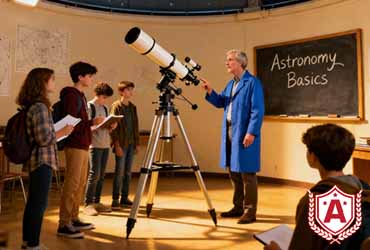 Have you ever looked up at the glittering night sky and thought about how galaxies, stars and planets shape the cosmos? Studying Astronomy in Poland can give you an opportunity to explore the universe through scientific study. This field helps students understand the universe using math, physics and different data tools. The course covers everything about planets, stars, cosmology or space technology while helping students grow analytical and research abilities. Poland also offers the ECTS credit system that allows students to study or do research in different European countries. Alongside theory, students can work hands-on in observatories and space labs to study real data from the universe. Today, Poland is now recognized for space research due to its modern labs, telescopes and worldwide collaborations. The country provides reasonable costs, a safe environment and expanding research opportunities. However, Studying Astronomy in Poland provides pathways to international research, academic and space tech careers. If you want to build a future in Astronomy, Anigdha will support you throughout your study abroad journey.
If you want to study Astronomy in Poland, you should first understand the admission requirements. We have listed the eligibility for both course levels below:
Bachelor’s Eligibility Criteria
Application requirements: Submit your online application with a passport copy, recent photo, legalized high school diploma and transcripts and pay the fee. If documents are not in English or Polish, some universities will require notarized translations.
Educational Requirement: Applicants should provide a completed secondary school diploma valid for university admission. However, It is recommended to have good grades in math and physics, usually 65% or higher.
Global requirement test: Most Polish universities check grades and the relevance of studied subjects when reviewing applications. Some programs may require entrance tests or checks in physics and math, depending on the university. Check the official program page for specific rules.
Additional requirement: Adding a CV, motivation statement and records of math or physics courses enhances your application. Some programs may ask candidates to do a short interview or online test.
English proficiency requirement: Students should have good English skills to join English programs. Here are some accepted tests and scores are:
IELTS : 6.0 overall
TOEFL iBT: 80 and above
Duolingo English Test: 105 points
Master’s Eligibility Criteria
Educational requirement: Applicants should hold a Bachelor’s degree in physics, astronomy or astrophysics and have good academic results. Many programs expect applicants to complete courses in calculus, classical mechanics and introductory astronomy.
Application requirement: Upload your bachelor’s diploma, transcripts, CV, passport copy and program details when submitting the online application. Pay the required fee before the deadline passes.
Additional requirement: A statement of purpose, two recommendation letters and sometimes a brief research proposal are usually required for master’s programs. However, research work or internships in the field improve your chances of admission.
English proficiency requirement: Applicants who don’t speak English as their first language must prove their English ability. Here are some accepted tests and minimum scores required:
IELTS: between 6.0 to 6.5
TOEFL iBT: between 80 to 90 points
Duolingo English Test: 105 points
Admission for Astronomy in Poland usually happens in two major periods each year. The fall session begins in October and the application period usually runs from May until July. The spring session starts in February or March, and the application period usually runs from November until January. Since admission deadlines may change across universities, applicants must keep checking the official portal for correct information.
The following documents should be attached when applying for a Bachelor’s in Astronomy in Poland:
Submit a properly completed application form.
Provide a photocopy of the passport ID page.
Attach your high school certificate with proper legalization or apostille.
Ensure all documents are translated into English or Polish with official certification.
Provide certified copies of your transcripts with detailed grades.
Attach recent colored photos in passport format.
Students must show English ability with IELTS, TOEFL iBT or MOI certificate.
Attach a valid health insurance document for Poland.
Submit a medical certificate confirming good health.
Here are the documents to submit when applying for a Master’s in Astronomy in Poland:
Attach a fully completed application form.
Submit a scanned passport copy showing your personal details.
Submit official undergraduate certificate or provisional and transcripts with required legalization.
Translate all required documents into English or Polish with certification.
Provide certified academic records with subjects and marks.
Ensure you submit a recent colored passport photo.
Attach a resume showing academic and professional achievements.
Submit academic or professional references as required.
Include evidence of English ability through IELTS, TOEFL or MOI.
General medical report showing good health.
Medical clearance confirming no major health issues.
Financial guarantee documents for tuition and living costs.
In Poland, many astronomy and astrophysics programs are taught in the Polish language whereas several programs in Poland now also teach astronomy in English for international students, covering observation, theory and data science. You can visit the program page to find information about language requirements and internal assessments. Below are the common minimum test scores, based on standard academic criteria.
Here are some common accepted minimums:
IELTS (Academic): 6.0 points
TOEFL iBT: 80 and overall
Duolingo English Test: 105 points
A Bachelor’s degree with an astronomy track in Astronomy or Physics normally runs for three years and six semesters. These programs include core physics and astronomy courses, labs, small research projects along with ECTS credits that allow students to continue to Master’s studies.
Most Astronomy or Astrophysics Master’s courses run for 1.5 to 2 years and include three or four semesters. The course focuses on advanced theory, observation projects, research methods, thesis work and internships to prepare students for PhDs or research roles.
It is crucial to check tuition fees of top Polish universities before starting an Astronomy course. Here’s a breakdown of common annual tuition fees for international students:
| Name of the University | Bachelor’s Fees/ Year | Master's Fees/ Year |
|---|---|---|
| Nicolaus Copernicus University | Annual fees range €1,800 to €3,500 for English-language physics or astronomy bachelor programs, depending on the program and citizenship | English Master programs in astronomy or astrophysics generally have yearly fees of €2,000 to €4,000. Check the admissions page for details. |
| University of Warsaw | Bachelor programs in English for science subjects generally cost €1,500 to €3,000 per year, based on faculty and specialization. | Master’s fees in physics or astrophysics range €2,000 to €4,000 per year depending on the course. See the university’s official fee table. |
| Jagiellonian University | Tuition for international students on English science programs typically falls between €2,000 and €3,500 per year. Confirm on the course page | International Master’s students usually pay between €2,200 and €4,500 per year. Exact fees are on the official website. |
| University of Wroclaw | The annual cost of English programs generally falls between €1,800 and €3,200. Contact admissions for precise fees. | English Master’s programs generally charge €2,000 to €3,500 yearly. Check with the faculty for exact amounts and payment terms. |
| Adam Mickiewicz University | Tuition for international students on science or astronomy bachelor tracks typically ranges €1,800 to €3,000 annually. See the official university fee list. | The fees commonly range from €2,000 to €4,000 annually. Verify the amounts on the official program page. |
Note: The fees listed are approximate and may vary with the program, student category and university regulations. Therefore, Tuition fees do not include additional expenses such as rent, meals, or academic supplies.
Poland has top public universities offering Astronomy, mainly in major cities with quality education at affordable tuition. Below is a quick look at some popular universities offering Astronomy program:
| Name of the University | Category | City |
|---|---|---|
| Nicolaus Copernicus University | Public | Torun |
| University of Warsaw | Public | Warsaw |
| Jagiellonian University | Public | Krakow |
| University of Wroclaw | Public | Wroclaw |
| Adam Mickiewicz University | Public | Poznan |
Poland offers a range of scholarships and grants for international students. The Polish National Agency for Academic Exchange (NAWA) provides scholarships that cover tuition and give a monthly stipend to outstanding students. Students with excellent academic or research promise can get university merit scholarships and Erasmus+ funds cover short Europe trips. Targeted funding is also available through regional or bilateral schemes for students from specific nations. Visit NAWA, university and embassy websites to confirm scholarship requirements and deadlines. Therefore, early preparation can make it easier to receive competitive awards and financial help.
Let’s walk you through the admission process for both bachelor’s and master’s courses to study Astronomy in Poland with a simple step-by-step guide:
Bachelor’s Admission Procedure:
The first step is to find universities in Poland with Astronomy programs.
Spend time researching and shortlisting programs and universities that match your background and goals.
Next, select universities from your list by considering grades, requirements and fees.
Once you pick a university, submit your online application and check the information thoroughly.
Gather essential documents like your apostilled high school certificate, transcripts, passport and English proficiency certificate.
Most universities require IELTS or TOEFL scores but a Medium of Instruction certificate can be an alternative.
Pay the required application or admission fee while submitting your application.
Once accepted, you’ll get an official offer letter, which is required for your student visa application.
Proceed with your Polish student visa application, arrange HRD and apostille authentication of required documents and finalize your travel plan.
Ensure you have accommodation arranged near your university or within campus before the start of your studies.
Master’s Admission Procedure:
Start your admission journey by identifying universities in Poland that offer a Master’s in Astronomy.
Identify programs that align with your learning style, academic profile and budget.
Check entry requirements and select programs that match your bachelor’s in Astronomy or similar fields.
Complete the online application with your bachelor’s diploma, mark sheets, CV, passport and English proficiency documents.
Depending on the university, additional documents such as recommendation letters or an SOP could be mandatory.
Prepare for language tests, including IELTS or TOEFL, if your program requires proof of English skills.
In many cases, universities ask for the first semester tuition fee to finalize your admission.
The university will send you an official acceptance letter, which serves as a mandatory document for your visa application.
Begin the visa process, ensure your documents are legalized or apostilled and purchase an appropriate health insurance plan.
As soon as your visa is issued, make your travel arrangements and confirm accommodation for a smooth start.
Are astronomy degrees taught in English in Poland?
Yes, Multiple universities in Poland provide astronomy and astrophysics courses in English for both Bachelor and Master degrees. You can also verify the program’s instruction language on its official page before submitting the application.
Do astronomy graduates find research jobs in Europe?
Graduates often take PhDs or roles in observatories, space agencies, data science or tech companies. International collaboration can provide more research opportunities.
Do applicants need research experience for Master’s courses in Poland?
Applicants with research experience may have an advantage, though it is not always needed. Therefore, strong academic performance and supporting letters are often crucial for acceptance.
How do I certify my foreign degree for admission to Polish universities?
Diploma recognition is verified by universities. Some students need apostilled or legalized documents with notarized translations. You must reach out to the university admissions office for confirmation.
Is Poland the right choice for Astronomy students?
Yes, Studying Astronomy in Poland means benefiting from low tuition, modern academic infrastructure, English-language programs and globally recognized degrees that open doors across Europe.
What is the duration of Astronomy programs in Poland?
A bachelor’s degree usually takes 3 to 4 years, and a master’s program runs for 2 years. The programs focus on both strong academic foundations and real-world training.
Get free 1-on-1 counselling with our experts