Updated on Dec, 08 2025 04:14 IST
Study Civics in Poland





Test Preparations
About Us
Knowledge Hub

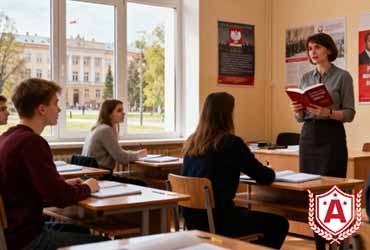 Have you ever wondered what makes a government work and how citizens contribute to it? Studying Civics in Poland can help you explore the relationship between government, law and active citizenship. The programme covers key areas including democracy, law, diplomacy and global justice. It gives insight into how people, governments and organizations interact within society. Universities of Poland promote active learning through classes and real-world analysis of social challenges. They also get involved in academic and community projects that build problem-solving and leadership qualities. However, Poland is widely known for its safe cities, affordable expenses and world-class universities. The ECTS system makes it easier for students to move between European universities and complete joint programmes. If you’re passionate about serving society and understanding how governments function, Anigdha will guide you toward your Civics degree in Poland.
The following are the eligibility requirements you must fulfill before applying for courses in Poland. We have divided the requirements for both bachelor and master’s levels to make it easy for you to understand.
Bachelor’s Eligibility Criteria:
Application requirement: Fill in the online form on the university portal, upload your high school diploma and grades, include translations where necessary and pay the application fee.
Educational requirement: You are expected to have completed high school and obtained a certificate recognized for university entry. High scores in civics, history and social sciences can make your application more competitive.
Global admission test: Most civics degrees don’t ask for GRE results, but some universities may require a quick test or interview. Check the course page carefully for details about entrance exams or evaluations.
Additional requirement: Along with the application, some programmes require a personal statement or interview. A well-prepared CV with community work makes your profile stronger.
English proficiency requirement: If you didn’t study in English before, you’ll need to show a language test result for admission. Universities also accept official test results like IELTS or TOEFL, or documents proving you studied in English before. Here are some common accepted scores are:
IELTS: Between 6.0 to 6.5.
TOEFL iBT: 72 to 90.
Duolingo: 95 to 105.
Master’s Eligibility Criteria
Educational requirement: Candidates should have a first degree focused on political or social studies such as law, sociology or public policy. Good academic standing for civics research makes your profile stronger.
Application requirement: Submit your bachelor’s diploma, transcripts, CV, motivation statement and research proposal where applicable. Pay the required fee and follow the portal updates to stay informed about application timelines.
Additional requirement: Many civics programmes include two recommendation letters, a brief research proposal and an interview. Applicants with experience in local government, NGOs, or policy work have an added advantage.
English proficiency requirement: Good English communication skills are essential for English-medium master’s studies. Universities often accept recognised English tests or your evidence of prior studies. Here are some common accepted scores are:
IELTS: 6.5 or higher.
TOEFL iBT: 80 to 95
Duolingo: 100 to 110
Polish universities follow two main intakes. The Fall intake commences in October, and applications are typically accepted from May to July. The admission period at many technical universities usually starts in May and closes around mid-July. A few institutions provide a Spring intake, where the admission process usually runs between November and January for February or March sessions. In most cases, applications are usually available about two to three months prior to the start of the semester. Therefore, students should apply as soon as possible because seats are limited and fill quickly.
Here is the list of documents to be applied for while applying for a Bachelor's in Civics in Poland:
Submit a correctly filled application form through the university portal.
Upload a photocopy of your valid passport showing your personal details.
Provide a recent colored passport photo following university guidelines.
Attach your secondary school graduation certificate.
Submit transcripts listing your subjects and results.
Translate your transcripts and certificates if not in English or Polish.
Legalize or get an apostille on your high school diploma if required.
Provide IELTS, TOEFL or other accepted English test results if required.
Provide a medical certificate showing you are fit to study.
Attach insurance documents according to university to visa rules.
Show bank statements or sponsor letters proving enough funds.
Attach optional materials like portfolios, letters or exam results if required.
Here is the list of documents required to be attached to your application form for a Master’s in Civics:
Complete the online application form specific to your Master’s course.
Send a clear passport copy with recent colored photos.
Attach your Bachelor’s degree proof as issued by the university.
Submit your complete academic record for verification.
Translate all academic documents into English or Polish and submit.
Get your degree and transcripts authenticated if required.
Show evidence of English proficiency for the Master’s program.
Submit an updated CV with education, experience and internships.
Attach a personal statement showing your academic motivation.
Attach recommendation letters supporting your application.
Submit a structured plan covering research aims and objectives.
Show funds through personal account statements or sponsorship.
The number of English-language civics and political science programmes in Poland is steadily growing for foreign students. English as the medium of instruction helps global students participate fully. However, some practical sessions or research work may require simple Polish communication skills. Here are some minimum accepted English scores are:
IELTS: Between 6.0 to 6.5 for bachelor and 6.5+ for master studies
TOEFL iBT: Between 72 to 95
Duolingo: 95 to 110
Most civics or political science bachelor degrees are completed in three years across six semesters. The programme includes essential theory, comparative modules and applied projects, offering optional internships in the final year.
The duration of a full-time civics master’s is usually one and a half to two years, depending on the course structure. The programme focuses on advanced theory, policy analysis and offers an optional dissertation along with practical projects.
It is important to compare tuition fees charged by top universities for Civics in Poland. Below is an overview across five leading institutions:
| Name of the University | Bachelor's degree | Master's degree |
|---|---|---|
| University of Warsaw | Most public universities set international tuition for English social science programmes between €2,000 and €4,000 per year | Non-EU candidates can expect fees around €2,500 to €5,000 per year for master’s studies. Check the programme page for details |
| Jagiellonian University | Tuition for English-track bachelor courses for international students usually sits between €2,000 and €4,500 yearly. | English-taught social science master programmes typically cost about €2,500 to €5,000 annually. |
| Adam Mickiewicz University | Bachelor tuition for international social science students commonly falls between €2,000 and €4,000 yearly. | Most non-EU master students pay between €2,500 and €4,500 per year. Check the university for potential fee reductions. |
| University of Wroclaw | Most English-taught bachelor degrees have yearly fees around €2,000 to €4,000 for foreign students. | Master tuition for international students usually sits near €2,500 to €5,000 yearly. confirm fees on the programme portal. |
| University of Lodz | Non-EU students should expect annual tuition of €2,000 to €4,000 for social science bachelor courses | The yearly cost for master’s programmes is typically €2,500 to €4,500. Always check the university for updates. |
Please note: The costs shown are indicative only and may differ according to income and study field.
Here are leading Polish universities where you may pursue your bachelor’s or master’s degree to Study Civics in Poland.
| Name of the University | Category | City |
|---|---|---|
| University of Warsaw | Public | Warsaw |
| Jagiellonian University | Public | Krakow |
| Adam Mickiewicz University | Public | Poznan |
| University of Wroclaw | Public | Wrolaw |
| University of lodz | Public | lodz |
Poland provides multiple scholarship and grant options for students studying social sciences from abroad. The Polish National Agency for Academic Exchange runs grant programmes for full-degree students, visiting researchers and mobility projects. Many universities provide merit or need based scholarships and tuition waivers for outstanding candidates. Bilateral agreements between Poland and other countries also fund students and researchers in public policy and civic studies. Through Erasmus+ exchanges, master students can spend time at European universities while accessing mobility funding. Universities often offer financial support for thesis research and practical fieldwork for research-based master students. However, early application and a strong motivation letter improve your chances.
This simple guide makes it easier to understand the admission process for studying Civics in Poland at both bachelor’s and master’s levels. This process could make it easier for you to meet requirements and complete the application.
Bachelor’s Admission Procedure
Explore English-language civics courses and review all eligibility criteria on the official faculty pages.
Create your profile on the university portal and provide accurate personal and academic details.
Submit scanned copies of your school diploma, transcripts, translations, passport and photo.
Upload valid English test results unless prior studies in English make it unnecessary.
Attach requested documents such as an entrance assessment, CV or motivation letter.
Pay the programme fee and check for any interview invitations or document requests.
Accept your offer online once results are released and complete enrolment procedures.
Apply for a student visa, ensure all original documents are ready and register on arrival.
Master’s Admission Procedure
Choose the track you wish to apply for and check the programme webpage for all requirements.
Provide your diploma and complete transcripts, along with certified translations to the online application.
Submit your resume, statement of purpose and any additional research documents or portfolio.
Attach reference letters and language test results or proof of English-medium degree.
Pay the application fee and be ready for any assessment or interview.
Accept your admission offer and follow the steps to pay fees or apply for scholarships.
Complete all visa, housing and travel arrangements before your arrival.
Submit your original certificates, register on campus and participate in orientation.
Can I study civics in English in Poland?
Yes. Several Polish universities offer English-taught political science and civics programmes for international students. However, you must confirm the language of instruction on each programme page.
What English score do I need for civics programmes?
Most bachelor tracks ask for IELTS 6.0 to 6.5 or TOEFL 72 to 90. Masters usually require IELTS 6.5+ or equivalent. Check the specific programme page for exact requirements.
How long is a civics bachelor degree in Poland?
A full-time bachelor in civics normally lasts three years across six semesters and includes lectures, seminars and practical projects.
Are scholarships available for international civics students?
Yes. Poland’s NAWA grants, university scholarships and some bilateral programmes support international students. Check NAWA and university pages for current offers.
Can I work while studying civics in Poland?
Non-EU students may work part time under the rules for international students. Check visa conditions and university guidance on permitted hours.
Will a civics degree from Poland be recognised in Europe?
Yes. Polish universities use ECTS and meet European standards, so qualifications are widely recognised for further study or work across Europe.
Get free 1-on-1 counselling with our experts