Updated on Dec, 08 2025 04:14 IST
Study Chemistry in Poland





Test Preparations
About Us
Knowledge Hub

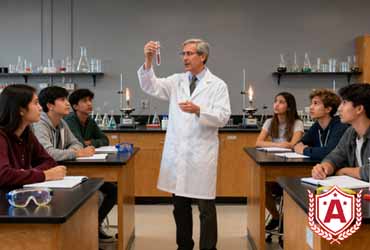 Are you curious about the composition of matter and science behind everyday things? Studying Chemistry in Poland gives you the chance to understand how materials interact and transform. It helps students understand all types of chemistry while applying experimental and laboratory methods. The program includes lab experiments, project work and practical training to help students think critically and solve real-world problems. Today, Poland has become a popular choice for its affordable tuition, easy living costs and degrees respected worldwide. Polish universities follow European standards, offering Chemistry programs recognized across Europe and worldwide. Therefore, studying in Poland ensures students get modern education, practical lab experience, safety, and global cultural exposure. If you are thinking of studying Chemistry in Poland, Anigdha can guide you through each step. Our service helps you choose the best university, discover scholarship opportunities and complete your applications.
Here is the detailed set of eligibility criteria that you must know before applying for Chemistry courses in Poland. Here we explain the requirements for both levels separately:
Bachelor’s Eligibility Criteria
Application requirements: Submit the online application through the university admissions portal with personal data, scanned passport, photographs, and high school documents.
Educational requirements: A completed secondary education and a school-leaving certificate are required to apply for a bachelor’s program in Chemistry in Poland. Students may also have to score well in maths and physics.
Global admission test: Some universities require a subject test or internal exam in chemistry or related sciences for shortlisting applicants.
Additional requirements: A motivation letter or statement of intent explaining your interest in chemistry may be requested by departments.
English proficiency requirements: If your chosen program is taught in English, you will need to demonstrate your language proficiency. This can be done by presenting one of the accepted proofs listed below:
IELTS: 5.5 to 6.0
TOEFL iBT: Minimum 72 to 80
Duolingo: Minimum score of 95 to 100
Master’s Eligibility Criteria
Educational requirements: Applicants are eligible for a master’s in Chemistry in Poland after earning a bachelor’s in biochemistry or a related area with scores of at least 55 to 60%.
Application requirements: Complete your online application, pay the required fee, and attach legalized or apostilled academic documents, translations, passport copy and a photo before the deadline.
Additional requirements: Some programs ask for a motivation letter, CV, letters of recommendation and when required, proof of work experience.
English proficiency requirements: When you choose English as your study medium, proof of language ability is required. You may present one of the following.
IELTS: 5.5 to 6.0
TOEFL iBT: Minimum 72 to 80
Duolingo: Minimum score of 95 to 100
Students can apply to Chemistry programs in Poland during either the Fall or Spring intake. The Fall intake is considered the main session. Applications are usually open from May to July, and the academic year begins in September or October. A number of Polish universities provide a Spring intake as well, where the application period runs from October to January and courses start in February or March. Therefore, It is advised to prepare early so that all documents, admission, and visa work are completed on time.
Here is the list of documents you must attach to your application form when applying for Bachelor’s in Chemistry in Poland:
Clear photocopy of the passport including photo and personal details.
Application form submitted in the prescribed format with signature.
High school documents verified and translated into English or Polish, if applicable.
Passport-style photograph with clear visibility and neutral background.
Personal Statement showing passion for Chemistry and study objectives.
Official document verifying English skills meeting B2 or higher requirements.
Detailed resume covering education, achievements, and relevant skills.
Signed recommendation from school or college faculty members.
Statement of financial capability issued by bank or sponsor.
Proof of health insurance effective for the full course duration.
Admission acceptance document confirming student selection.
Additional credentials demanded by the respective academic institution.
Here is the list of documents required to be attached to your application form for a Master’s in Chemistry in Poland:
A clear copy of the passport’s identification page.
Degree certificate along with academic records, properly legalized.
Certified academic transcripts with a record of subjects and grades must be attached.
Recognition statement or qualifying certificate showing eligibility for postgraduate study.
Language test results confirming at least B2 proficiency in the chosen language.
Recent photo as per passport size requirements.
Filled and signed application form according to university rules.
Receipt showing payment of the application fee, if applicable.
Proof of medical insurance that covers your stay in Poland.
Poland provides a range of English-taught Chemistry courses for students at all degree levels. These courses are designed according to global academic standards and attract international students. These are taught by experienced teachers and include practical labs, seminars and research. However, studying Chemistry in English allows students to read international research and collaborate across borders. Below are some accepted test scores:
IELTS: 6.0 to 6.5
TOEFL: 80 to 90 points
Duolingo: 95 to 105 points
The bachelor’s in Chemistry in Poland normally lasts three years and includes six semesters. The program includes core chemistry courses, lab work and electives for specialized learning.
The Chemistry Master’s program takes about 2 years, spread over 4 semesters. The course focuses on advanced chemistry topics, methodology training and a research thesis.
| Name of the University | Bachelors Fees/ year | Masters Fees/ year |
|---|---|---|
| University of Warsaw | EU students are charged about 5,000 PLN annually for chemistry bachelor studies, while non-EU students pay nearly €3,200 for their first year. | The chemistry master’s program costs 12,400 PLN a year, with semester fees of 6,200 PLN, applying equally to EU/EEA and non-EU students. |
| Adam Mickiewicz University | No confirmed tuition details for chemistry programs are available through official sources. | Chemistry master’s tuition information was not available on official sites at the time of search. |
| Wroclaw University of Science and Technology | Annual tuition for EU and grouped students is around €2,900 (€1,600 per semester), while non-EU students face higher costs, approximately €3,900 each academic year. | The Master’s in Chemistry carries annual tuition of €2,900 for EU and grouped countries. For non-EU students, the yearly fee is higher at €3,900. |
| Gdansk University of Technology | The program fee for the chemistry bachelor’s is €2,200 per year, covering the full-time three-year course for international students. | The Master in chemistry costs €4,246 per year, giving students quality European education with strong academic support and career-focused human resource training. |
| Jagiellonian University | The cost of studying chemistry in Poland at the bachelor’s level is about €2,000 per semester, or €4,000 per year. | A master’s in chemistry is taught in English on average €2,000 per semester, amounting to €4,000 annually for those studying full-time in Poland. |
Note: Tuition fees vary by university, study level and student origin (EU vs non-EU). Always check official university websites for the most current and exact fee details.
Here are some of the top Polish universities where you can pursue your desired bachelor’s or master’s course of Chemistry in Poland.
| Name of the University | Category | City |
|---|---|---|
| University of Warsaw | Public | Warsaw |
| Adam Mickiewicz University | Public | Poznan |
| Wroclaw University of Science and Technology | Public | Wroclaw |
| Gdansk University of Technology | Public | Gdansk |
| Jagiellonian University | Public | Krakow |
Many Polish institutions offer scholarships that reduce costs for Chemistry studies. The Ignacy Lukasiewic Scholarship under NAWA supports Master’s engineering students by covering fees and offering monthly financial aid. The Poland My First Choice NAWA scholarship assists second-cycle students by removing tuition costs and offering monthly financial support. At Warsaw University of Technology, top-performing engineering applicants can receive merit scholarships that cover up to 50% of tuition fees. However, such scholarships and support make a degree in Chemistry in Poland within reach.
Here is a simple admission process you should follow to secure your seat in Poland for both levels of study:
Bachelor’s Admission Procedure
Students should begin by exploring all Chemistry programs offered by different universities, considering structure, tuition, faculty expertise and laboratory facilities.
It is also advised for applicants to match their academic records and professional goals with the prerequisites of the chosen university.
Ensure that the online application is fully completed and submitted on time through the university’s official website.
Before submitting applications, students must organize academic records, while Anigdha supports document preparation and entrance test readiness.
Completing the fee payment process is essential for the application to be formally accepted by the university.
Once your application is approved, you will receive a formal offer letter that is essential for visa processing.
Complete student visa formalities, authenticate all necessary documents and arrange your flight and accommodation.
Finalizing housing close to the university before arrival ensures smooth adjustment and convenience during the academic term.
Master’s Admission Process
The first step is deciding on your field of study like Chemistry, according to your strengths and future career plans in Poland.
Before applying, make sure your prior education meets the university criteria, usually a Bachelor’s degree in a relevant field.
Collect and organize all required documents including academic records, certificates and passport copies before starting your application.
Complete your chosen course application, submit all documents accurately and Anigdha will guide you through the process.
Fill the online form, pay fees, check for updates regularly and prepare for an interview if the university requires one.
After receiving the admission letter, submit it along with your passport, funds proof and health coverage for the visa.
After a 45-day visa processing period, students must complete HRD verification and apostille authentication of all documents.
Upon arrival, complete the registration process with original academic papers and payment of tuition fees.
At last, students should finalize their accommodation in hostels or private rentals close to the university campus.
Are there any age restrictions for applicants?
There are usually no age limits for admission but some universities may consider age as part of their selection criteria.
Is work experience required for admission?
Bachelor’s degrees are open to students without work experience, while Master’s degrees, particularly MBAs often prefer relevant professional backgrounds.
Is Chemistry in Poland taught in English?
Yes, students may choose to study English in Poland. Universities allow students to take bachelor's or master's courses across a variety of subjects.
Is Poland cheaper than other European countries for studying chemistry?
Yes, Compared to Western Europe, Poland offers lower tuition fees and monthly living costs between €350 and €600.
Can I work while studying?
International students holding a student residence permit in Poland are allowed to work without needing an additional work permit.
Are scholarships available for Chemistry students in Poland?
Scholarships such as the Stefan Banach Program, Erasmus Mundus and the Visegrad Fund are available, offering both tuition coverage and financial aid for daily expenses.
Get free 1-on-1 counselling with our experts